
1966
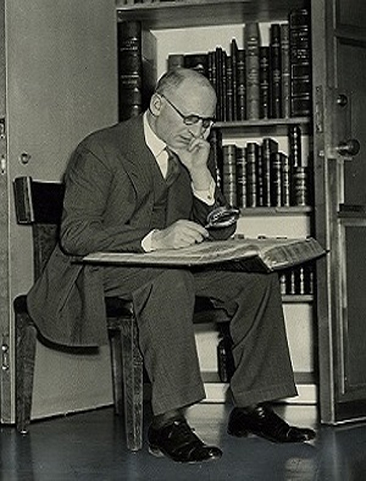
Yes, Lessing Rosenwald was no mere art hoarder; in fact, he really was not an art hoarder at all. At any given time, items from his prized collection of prints and rare books could be found at up to sixty national and international exhibits. At the time of the Award, his print collection numbered 25,000 and included works by Rembrandt, Picasso, Munch, and Matisse. His prized book collection of some 2,500 titles included the first illustrated Bible (the Giant Bible of Mainz), published in German in 1475; Epistolae et Evangelia (1495)—known as the “finest illustrated book of the fifteenth century”; and a “Baedeker-like guide book to Rome” (1488). He believed “that a work of art that is never seen is little better off than one that has never been created.” In 1943, Rosenwald announced that (upon his death), he was leaving his rare books to the Library of Congress and his prints to the National Gallery of Art.
In the meantime, his magnificent collections were available for public perusal at the Alverthorpe gallery, the fireproof wing of his mansion in Jenkintown. This perusal was by appointment only, but appointments were made steadily at first and gradually came in fast and furious, as many thousands visited the gallery. Heir to the Sears & Roebuck fortune, Rosenwald opened Alverthorpe in 1939, shortly after he retired from his position as chairman of the board of Sears and Roebuck, in order to devote himself full-time to his collections and philanthropy.
When at home, Rosenwald often greeted visitors to the gallery, shook their hands, inquired about their visit, and joked with them; he was thrilled by the great interest in his collection, not only from art connoisseurs and scholars, but from groups of adults and school children who arrived with little knowledge and left stimulated by what they had seen.
Rosenwald received the Philadelphia Award, not for amassing a great collection, but for making that collection available to the public, especially at Alverthorpe. He was also honored for his “dedicated intelligence,” which he had demonstrated by his work developing the print and drawing department of the Philadelphia Museum of Art, expanding the rare book department of the Free Library, and founding the Print Council of America.
1965
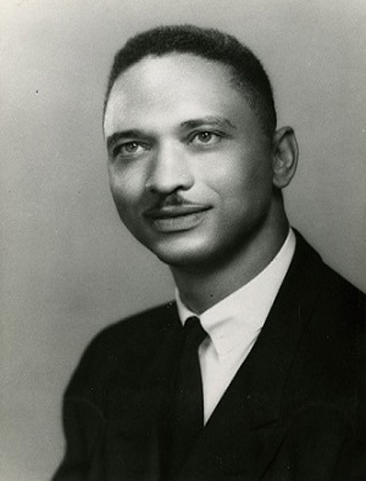
Sullivan grew up poor in West Virginia, reared by his devoutly Christian grandmother. He graduated from West Virginia State College, and earned a degree from Union Theological Seminary in New York City. In 1950 Sullivan became pastor of ZionBaptistChurch in North Philadelphia. Shortly afterwards, Sullivan founded the Citizens Committee Against Juvenile Delinquency and its Causes, which organized people in low-income black neighborhoods to clean up their blocks, supervise teenagers, and protest nuisance bars.
In 1960 Sullivan and other black ministers founded 400 Ministers, to combat job discrimination. He estimated that in Philadelphia less than 1 per cent of private sector jobs involving contact with customers were held by African Americans; these jobs included clerks, bank tellers, and sales people. Few blacks held skilled factory jobs. 400 Ministers organized boycotts of Tastykake, Sun Oil Company, and five other businesses, forcing those companies to change their practices. “After the Tasty victory,” Sullivan recalled, “black people were walking ten feet tall in the streets of Philadelphia.” Numerous companies avoided boycotts by reaching agreements with the group.
In 1964 Sullivan opened the Opportunities Industrialization Center to provide vocational training for black youths. The center soon featured eight training programs, including sheet metal working, electronics assembly, and restaurant services. With corporate, foundation, and federal funding, the OIC grew into a national job training organization, operating in 150 cities by 1970.
Sullivan devised the 10-36 Plan, where parishioners would donate $10 every month for 36 months (for 16 of those months the money would go to a community nonprofit, the last 20 months to start a black-owned business). After their contributions, the parishioners were voting shareholders in the business. The largest enterprise the plan launched was Progress Plaza, a shopping complex near Temple University.
Later, he gave his name to an early driving force against the Apartheid regime in South Africa, the Sullivan Principles. These principles required international companies doing business in South Africa to ignore the race segregation laws, provide equal pay for equal work, set up training programs, and promote non-whites to supervisory positions. While companies such as Ford and GM (where Sullivan was a board member) were quick to sign on, the principles themselves had mixed success and were abandoned in 1987, when Sullivan endorsed a full economic boycott of South Africa. In 1999 Sullivan adapted the principles internationally as the Global Sullivan Principles of Corporate Social Responsibility.
In 1988 Sullivan retired as pastor of Zion Baptist, in order to devote himself to international work. He organized summits that brought together Africans and African-Americans. At the Millennium Summit in Ghana, over 3,500 attended, including the leaders of 19 African nations.
Sullivan was a tireless proponent of self-help. He inspired and assisted thousands of African-Americans in starting up businesses and learning skills to improve their economic well being. As Sullivan explained, “I long to see the kingdom of God a reality in the everyday lives of men. Some people look for milk and honey in heaven, while I look for ham and eggs on earth.”
Sullivan received honorary doctorates from over 50 institutions. President Bush awarded him the Medal of Freedom in 1992. Bill Clinton presented him with the Eleanor Roosevelt Award in 1999.